A Treasure Beyond Measure: The Importance of God’s Word
What a young woman in Kenya taught me about a treasure I’ve had all my life.
I recently returned from a trip to Kenya, and one of the most memorable moments of the entire trip happened in a small church in Turkana. It wasn’t a dramatic moment. No miracles or voices from above. In fact, it was a rather ordinary moment with a young woman, a well-worn Bible, and remarkable joy.

I don’t know her name and didn’t speak her language, yet she taught me – reminded me – of something I always need to remember. And maybe you do, too.
God’s Word is a treasure.
A Bible Worth Treasuring
Our first couple of days in Kenya were spent in Turkana, a hot, desert region and one of the poorest areas of the country. GOA, the ministry we were visiting, has been working there for years. One of our church’s earliest projects in the region was providing a well, or borehole as they call it, near a small church.
But not a church as we usually think of it.
This church was literally just the people, as all churches are meant to be. They met under a tree near a dry riverbed that holds a little water only a few times a year.
After the borehole was drilled, more people came to the area. First for the water. Then for the Living Water.
As the church grew, they built a meeting place, started a school, added an adult school, and recently planted another church a few miles away. We were privileged to visit the church and both schools.
At the adult school, our team leader, Jay, was asked to share a short devotional. He asked for a volunteer to read a verse in Swahili.
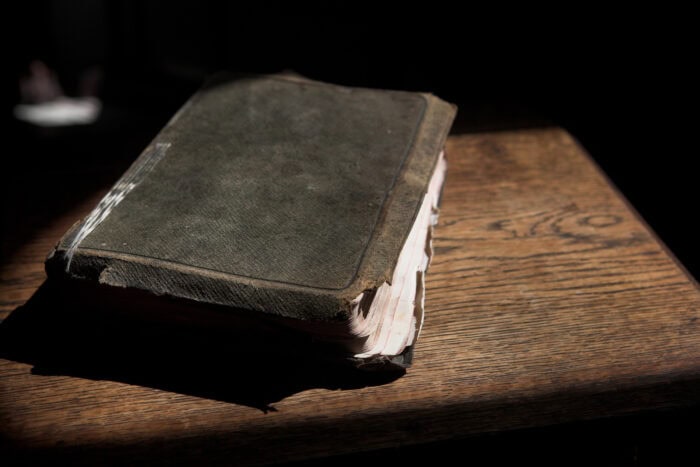
A young woman’s hand shot up instantly. We later learned she was almost at the end of the three-year program. She opened a Bible we would generously call well-worn. Others might say falling apart. That mattered not a bit.
As she read the verse, her face lit up with “unspeakable joy” (1 Peter 1:8). Her evident pride in being able to read God’s Word brought a smile to my face.
Later, when we visited the church, something similar happened.
The same young woman volunteered to read, picking up the same worn, well-used, and clearly well-loved Swahili Bible. This time the passage was too difficult for her, so the local pastor helped.
But she wasn’t embarrassed by her struggle. She was delighted to have the opportunity to read God’s Word.
Later, I learned something that made those two moments even more meaningful.
That old, worn Bible was the only Bible the church and adult school had to share.
The pastor had his own Bible, but the approximately 80 believers in that congregation shared just one. Most of them had no need for one – yet! – as they hadn’t yet learned to read. But many were learning and they all shared that one precious treasure.
One Bible. Eighty believers. And a young woman who knew what a blessing – what a privilege – it is simply to open it and read.
When Abundance Makes Us Forget
I’ll admit that I felt a little guilty. Not because those believers had so few Bibles, although I certainly wish every one of them had their own.
But because of how many Bibles we have.
I suspect there are at least a dozen in our home. Maybe more.
The same is true for most believers in America and throughout the West; at least all the ones I’ve met over 40+ years of walking with Jesus and belonging to a wide variety of churches in many states and countries as we moved around.
We privileged believers have study Bibles, devotional Bibles, and Bibles in different translations. We have Bible apps on our phones, Bible websites on our computers, and countless resources to help us understand Scripture.
If I want to look up a verse, I can have it in front of me in seconds.
We have access to God’s Word in ways that most Christians throughout history could never have imagined. And yet, how easily we neglect it. We can go for days without opening our Bibles. Sometimes weeks.
We can spend hours scrolling through social media, watching television, or reading the news, but struggle to find 15 minutes to spend in Scripture.
And even when we do read, how often are we simply checking something off our list?
I don’t say this to make anyone feel guilty. I struggle with some of these things myself. But I wonder whether our abundance has made us forget the value of what we possess. Hundreds, maybe thousands or tens of thousands of believers through the centuries have died for the privilege of having a Bible in a language they could read for themselves.
In so many countries today, owning a Bible can result in imprisonment, persecution, or even death. And yes, because we have such easy access to something so precious, it has become commonplace. To us – not to others and certainly not to the Lord.
And definitely not to that young woman in Turkana.
When God’s Word Was Rediscovered
There’s an interesting story in 2 Kings 22–23 about another time God’s people had neglected His Word.
King Josiah was only eight years old when he became king of Judah. Years later, during repairs to the temple, the high priest Hilkiah discovered the Book of the Law.
Think about that.
God’s people had the temple. They had priests. They had a long history of worship and religious tradition. But God’s written Law had been so neglected that its discovery was significant news.
When the book was read to Josiah, he tore his clothes in grief. He realized how far the nation had strayed from God’s commands, and he recognized the seriousness of their disobedience. Out of that conviction and desperation, he commanded Hilkiah and others to
“Go, inquire of the Lord for me, and for the people, and for all Judah, concerning the words of this book that has been found. For great is the wrath of the Lord that is kindled against us, because our fathers have not obeyed the words of this book, to do according to all that is written concerning us” (2 Kings 22:13).
He saw clearly that God’s people were in a bad state. He knew a holy God would not – could not – withhold righteous judgment. Instead of giving up in despair, he mourned and repented (2 Kings 22:11, 18-19), sought wise counsel (2 Kings 22:12-20), and determined to choose a new course for the nation.
King Josiah commanded the leaders and all the people to come to Jerusalem. When gathered, the king himself read aloud God’s Word and renewed the covenant. That was step one. But commitment without action quickly dissolves.
Josiah knew decisive action was needed. He immediately began removing the idolatrous practices that had become embedded in Judah’s life. The idols were destroyed, their altars demolished and desecrated. False priests were executed. Josiah removed mediums, necromancers, household gods, and all other wickedness. He turned to the Lord as no king – including David – had ever done. (2 Kings 23:1-25).
And when the land was purged of idolatry and wickedness, Josiah observed the Passover – he returned worship to its rightful place. Such was the restoration that Scripture tells us that “no such Passover had been kept since the days of the judges who judged Israel, or during all the days of the kings of Israel or of the kings of Judah” (2 Kings 23:22).
The rediscovery of God’s Word resulted in repentance, reform, and righteousness. And it led directly to restored worship.
And I think there’s an important lesson here for us.
It’s possible to be surrounded by the things of God while neglecting the Word of God.
We can attend church, participate in Bible studies, listen to Christian podcasts, and fill our homes with Christian books. We can play worship music in our homes, belong to small groups, and even serve in ministry.
All good things.
But those good things can never be enough. Nothing – no habit, practice, or ministry work – can replace personally knowing, believing, and obeying what God has said.
You may have thought I was going to say, “can replace personally knowing Christ as Savior.” And that’s a true statement. But I didn’t for this one reason: knowing Christ as Savior is intimately connected to knowing, believing, and obeying God’s Word. Jesus is the Living Word (John 1:1); the Bible is the written Word (Mark 7:13; 2 Timothy 3:16-17).
If we do not know, believe, and obey God’s Word – even if imperfectly – how can we claim to know, believe in, and obey Christ as Savior and Lord?
Josiah understood that God’s Word wasn’t simply information to be possessed; it was truth to be received and obeyed. Are we like Josiah? Or like the person in James 1, a hearer of the Word only, but not a doer (James 1:22-25)?
The Importance of God’s Word: More Precious Than Gold
The psalmist understood the extraordinary value of God’s Word.
In Psalm 19:10, he describes God’s words as more desirable than gold, even much fine gold, and sweeter than honey.
And Psalm 119:72 declares: “The law of your mouth is better to me than thousands of gold and silver pieces.”
God’s Word is worth more than wealth. More than the things we spend so much of our lives pursuing.
Why?
- Because Scripture reveals who God is.
- It teaches us what is true, what is good, and what is right.
- It exposes our sin, points us to our Savior, and teaches us how to live in ways that honor Him.
- It provides wisdom when we’re confused, comfort when we’re grieving, correction when we’re wandering, and hope when life seems overwhelming.
- As Paul writes in 2 Timothy 3:16–17, Scripture is God-breathed and useful for teaching, correction, and training in righteousness so that God’s people may be equipped for every good work.
God hasn’t given us His Word merely to inform us. He’s given it to transform us. And that transformation requires more than owning a Bible. It requires listening to what God says and responding in faith and obedience.
Does God’s Word Have a Grip on You?
I don’t tell you the story of that young woman in Turkana because I want you to pity her.
Quite the opposite.
I admire her. She knows, in a way many of us have forgotten or perhaps never learned, what a remarkable treasure God’s Word is.
She wasn’t embarrassed to read it. She wasn’t embarrassed to stumble over difficult words. She was honored to have the opportunity.
Of course, I’d love for her to have her own Bible. I’d love for every believer in that church to have one, and for every person in that community to learn to read.
That is important work.
But throughout much of Christian history, many believers had little or no personal access to written Scripture.
Instead, they heard it read and preached. They memorized it. They repeated its truths to one another. They carried God’s Word in their hearts.
They may not have owned a Bible.
But God’s Word owned their hearts.
And that’s the challenge I face constantly. The challenge you face every day.
Does God’s Word own my heart? I can carry a Bible wherever I go. I can keep one on my nightstand or in my car. I can open a Bible app whenever I want. I can even do my devotions and join Bible studies.
But the question remains: Does God’s Word own my heart? I may claim Jesus owns my heart, but His own words will challenge my claim: “If you love me, you will keep my commandments” (John 14:15; see also verses 21, 23 and 1 John 2:3; 3:24; 5:1-3).
- Am I allowing it to shape my thinking, my priorities, my relationships, and my choices?
- When Scripture challenges something I believe, am I willing to change my thinking?
- When it exposes sin, do I repent?
- When it calls me to obedience, do I obey?
- Or have I become so accustomed to having God’s Word available that I’ve forgotten what a privilege it is to hear from the God who created me?
Treasure It. Read It. Live It.
I don’t think the answer is to make ourselves feel guilty about how many Bibles we own. Nor do I think the answer is another complicated Bible reading plan that we’ll abandon after a few weeks. Perhaps the first step is simply remembering what we’re holding when we open our Bibles.
These aren’t merely ancient writings, inspirational thoughts, or religious instructions. These are the words God has given us so that we can know Him, understand His ways, and learn to live faithfully in His world.
And what a remarkable gift that is.
The Judah of Josiah’s day didn’t forget God’s Word all at once. The testimony of Scripture is that it resulted from one small failure to obey at a time. Bit by bit. Day by day. Until moments became months, then years, and finally generations. Until the knowledge of this holy treasure was forgotten.
They still had all the trappings of faith, but little to none of the reality. The challenge for us isn’t about how many Bibles we own, hours we spend studying Scripture, or Bible verses we can quote.
It’s about humility, obedience, and seeing the Bible for what it truly is: life-giving, life-changing, irreplaceable treasure – priceless gift – from the God of the universe to all humanity.
I want to approach Scripture with the joy of that young woman in Turkana.
I want to receive it with the humility of Josiah.
I want to value it as the psalmist did, more than gold and sweeter than honey.
And I want God’s Word to have such a firm grip on my heart that it shapes every part of my life.
That young woman reminded me what a privilege it is simply to open a Bible and read the words God has given us.
May this priceless treasure never become common to me. Or you.
I return to this question again and again: Does God’s Word – living and written – have my heart? Does it – does He – have your heart?


