A Biblical Worldview: 5 Theological Foundations
The first article in this series on Women in Crisis looked briefly at statistics in seven broad categories. This article lays out the Scriptural framework for examining these areas in greater detail from a biblical worldview. Future articles will look at each of the seven areas in depth, along with how the church might respond.
I became a Christian in 1980, at the tail end of the Jesus Movement that grew out of the rebellion and cultural upheaval of the 1960s. It was also at the leading edge of the megachurch movement that would have a massive and ongoing impact on evangelical churches across the United States.
I was 17, at the end of my junior year of high school. Looking back, I’m not sure how I came to saving faith. Oh, I know theologically how it happened. I recognized my sinfulness, repented of my sin, then asked for forgiveness and cleansing, a miracle of rebirth that can only be accomplished by grace through Jesus’ death and resurrection. That part I understand as much as I’ll ever understand grace.
The part I don’t quite get is the “why me” part. I grew up in a military family, going every week to Catholic Mass at the base chapel. I was baptized as an infant, went through confirmation, belonged to the youth group.
I didn’t understand the gospel. Aside from going to confession regularly, I don’t remember much talk about sin, either in general or personally. I wasn’t the only one who didn’t understand the gospel. None of us did, as far as I could tell. Even now, more than four decades later, I see no evidence of such understanding, as each is still walking the “I’m in charge of my own life and doing just fine, thank you very much” path. So how and why the Holy Spirit made plain to me the truth of sin, judgment, salvation, and grace, I’ll never quite understand.
I’m not saying that to brag, only to provide what I think is a necessary background to what follows here. There is nothing in me that deserves salvation or has earned God’s grace. For reasons known only to Him, He chose me, He redeemed me, He adopted me, and He has given me new life. All of eternity will never be enough to thank Him for this unspeakable gift.
Throughout this article, I use the word believer to refer to someone who has placed his (or her) faith in Jesus Christ as Savior and Lord. A believer recognizes his (her) own sinfulness, repents of sin, and trusts in Christ’s death and resurrection as the only basis for forgiveness and salvation, which is a gift of God’s grace and not something that can be earned. Believers possess a genuine faith that acknowledges Jesus as Lord and seeks to live in obedience to Him.
I begin with this background to say this: I entered the evangelical world as something of an outsider, without many assumptions about how church was supposed to work. I think it’s also important that I became a believer at the intersection of two powerful movements in American evangelicalism. They both undoubtedly colored my thoughts and understanding of faith, in particular, how evangelicalism has evolved from mid-twentieth century traditions to the more common expressions we see in churches today. In other words, I’ve been influenced by both the old and the new, and I had to navigate that shift while also moving from nominal Catholicism to biblical faithfulness.
Add to that my natural tendency to analyze and ask questions, and over the years I found myself asking a lot of “why” questions. Not out loud and not to any person, but in my mind, I’d wonder, “Why does this church do that?” Because we moved so frequently, I have been a member of 12 evangelical churches since being saved, including Nazarene, Southern Baptist, Christian, and nondenominational.
These churches were spread across several states and included rural, suburban, and urban communities, many with a strong military influence. For several years, we also belonged to an English-speaking evangelical church in Germany which included military and civilian American families, plus others from English-speaking nations around the world. Across these regions, cultures, denominations, and churches, I have observed, learned, and questioned. And in that process, I have tried to always hold those unanswered questions and concerns up to the clarity of the Word of God.
Why am I going into such detail about my personal history here? Because it explains something about the lens through which I approach the questions I’ll be asking, and possible answers I’ll be suggesting over the next several articles, as I consider what women’s ministry could be in evangelical churches today.
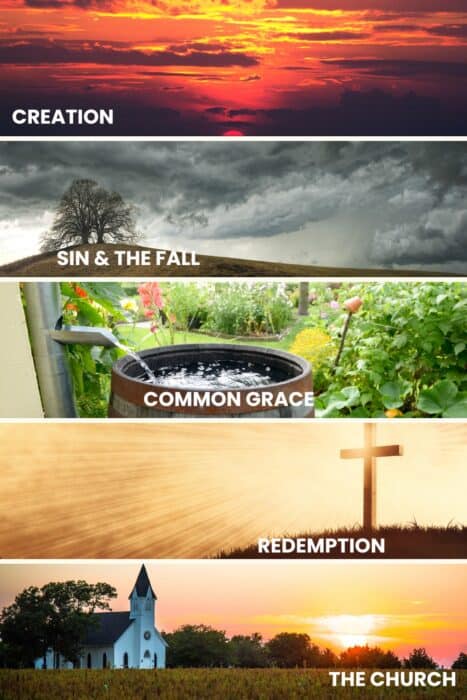
Before getting to the questions and answers, having a firm foundation to build on is critical. The basis for any Christian ministry should be rooted in Scripture and a clearly biblical worldview. Therefore, in the remainder of this article, I’ll lay that foundation, focusing on five key elements of faith: creation, sin and the fall, the common grace of God, redemption, and the universal Church.
Foundational Beliefs of a Biblical Worldview
Creation: Echoes of Perfection in a Broken World
We live in a beautiful world. No matter where a person lives, even in the most crowded, poverty-stricken corners of the globe, beauty can be found. Sunrises and sunsets still startle seventy-year-olds with their glory. Flowers, sometimes just dandelions, break through concrete to proclaim the bright yellow promise of life. Children stop to marvel at the beauty of butterflies and the delicate spots on a ladybug.
Through the miracle of technology, almost anyone can get a glimpse of towering redwoods in California, the power of Victoria Falls in Africa, or the massive Amazon basin covering 40% of the South American continent.
I could go on, but the truth is easy to see: this is a world of astounding beauty. We see glimpses of God’s original masterpiece all around us.
At the same time, we live in a world of brokenness. Hurricanes, tornadoes, floods, wildfires, and extreme heat and cold claim the lives of too many each year. Crime is evident in every nation, every tiny village. Lives are forever changed by diseases we intuitively know shouldn’t exist. Hearts cry out, “This is wrong!” when a child dies from cancer, a young mom is debilitated by a stroke, or a family loses its husband, father, and provider through a massive heart attack just when their sons need his strong hand to guide them into adulthood.
“This is wrong!” our hearts cry out. And we are not wrong.
The world was created perfect, beautiful, having everything needed for human flourishing – a wholeness we constantly, desperately struggle to find. We humans were created for that perfect world. And when sin stole it from us, it did not take our intuitive sense that it should exist. We are left with an aching soul, aching, often, for what we do not know. All so many of us can say is, “This is wrong!”
So we cling to the beauty we see, the good glimmering through the cracks of brokenness, the hope built into our very souls, while desperately trying to make sense of what is and find a solution for all we know is wrong.
Because we know, because God has placed it in our hearts (Eccl. 3:11), that we were made for more. We were created for an unbroken, perfect world of harmony, peace, and abundant flourishing. And we walk through our lives, wondering what happened.
Sin & the Fall
What happened is sin. Scripture tells of that beautiful, perfect world God created “in the beginning” (Gen. 1:1). Scripture also explains what happened to it, to us.
There was one command: “Don’t eat of the tree of knowledge of good and evil” (Gen. 2:17).
There was no need, no lack, no pain, no poverty, no loneliness. There was only abundance and peace and joy and beauty. And one command.
The command was broken, and the perfection became brokenness. Sin entered the world and all humanity, tainting everything and everyone with a debilitating, incurable disease. Incurable, except for grace.
Death became normal; it had never existed before. Pain became ordinary; it had never existed before. Strife, anger, resentment, and broken relationships all became normal. And we think of them as normal still. They are not. They are simply the results of sin infecting a perfect world.
We look around us and all we see is brokenness: broken homes, broken families, broken people. Corrupt governments, unrelenting poverty, wickedness and crime in every culture, every nation, every small corner of the world. Even the natural world appears broken, as we witness hurricanes, wildfires, tornadoes, and other devastating natural disasters wreak havoc, bringing heartache, death, and destruction around the world. This last statement may seem confusing, or even unbiblical, to some. So I’ve decided to explore it more deeply in a future article.
This is the effect of sin. Whenever you see something and think, “That shouldn’t be happening,” you are recognizing the impact of sin. Whenever you see someone, including yourself, and think, “That person should be or do better,” you are recognizing the impact of sin. You see it every day. So do I. So does everyone else.
Most people don’t know what to call this brokenness or what to do about it. Believers in the One True God, who know His Son Jesus Christ as Lord and Savior, we know. We know it is sin and the effects of sin. And because we know what this brokenness is, and because we know what the cure, the only cure, is, we alone can offer true hope to the broken people around our world, around the corner, and inside our homes.
It is sin, and it makes everything about living a flourishing human life harder than it should be. But God is good and He has not left us without any recourse. He has provided two vital blessings for all of us: common grace and a means of restoring what is broken, which is called redemption.
Common Grace
Common grace is not a common term. Perhaps you’ve never heard the term before. No worries. Because, even without knowing the phrase, you know what common grace is.
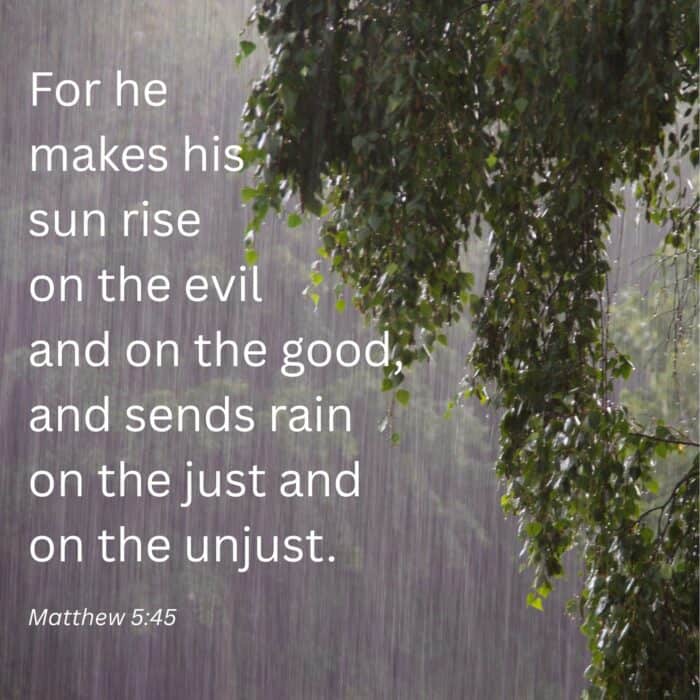
It is the sun that rises and the rain that falls on the “evil and the good…the just and the unjust” (Mt. 5:45). It is the beauty of creation that reveals the glory of God (Ps. 19:1; Rom. 1:20). It is the internal moral code written on human hearts (Rom. 2:15) and the intuitive sense that death doesn’t end our existence (Eccl. 3:11). It is the existence of governments which are meant to punish the wicked, even though many fail (Rom. 13:4), and the family which God designed for relationship, safety, and procreation (Gen. 1:28; Eph. 5:22-33; 1 Tim. 5:8).
These are some of the more obvious elements of God’s common grace to all humanity. Others, perhaps less recognized, are just as important. When God created humanity in His image, part of that image meant we were created with imagination, intelligence, and a desire or drive to create, learn, and understand. How is that common grace? Simply that those traits are what have given us indoor plumbing, open-heart surgery, high-speed rail, commercial aircraft, and central air and heating, among other blessings of modern life.
Science, perhaps the greatest hallmark of modern life, is only possible because the common grace of God gave not only intelligence and creativity, but also knowable, discoverable natural laws. God could have, because He is God, created a universe that acted irrationally, that was not predictable. In such a case, science could not exist – and neither could any of its blessings such as antibiotics or cars or Spandex.
In other words, all that is good in the world, all that exists that makes human life possible and human flourishing feasible, is the common grace of God. But common grace, as wonderful and important as it is, is not enough for what ails our broken world and all humanity. For that we need God’s second, far more consequential, gift: redemption.
Redemption and the Hope of Restoration
The world is broken; we know this, we see it, we feel it, and the Bible affirms it (Rom. 8:21-22). Scripture makes clear that creation, the natural world, will one day be made new (Is. 65:17; 2 Pet. 3:13; Rev. 21:1). Romans 8 tells us that creation is even groaning, waiting to be “set free from its bondage to corruption” (8:21). But what of humanity?
Scripture, in the same Romans 8 passage, tells us that believers likewise “groan inwardly” even “eagerly,” waiting for the “redemption of our bodies” (8:23). The natural world will be destroyed and recreated in perfection. But what about humanity?
Humanity, we can all confirm, is groaning along with nature. Our bodies wear out. We get sick. We die. Yet, in almost every culture around the world and throughout history, as seen in archaeological evidence, we collectively hold on to hope for life beyond this life. We seem to sense, as a species, that this life is not all there is.
Scripture agrees. Job declares he will see God after his body is destroyed (Job 19:25-26). Daniel prophesies that those who “sleep in the dust will awake” to either everlasting life or everlasting contempt (Dan. 12:2). Jesus teaches us of the resurrection to life or to judgment (Jn. 5:25-29). In these and many other Scriptures, humans existing beyond this life is presented as a firm fact in the Bible.
Everyone, without exception, will have an eternal existence after their earthly death. Unfortunately, because of sin, we are destined to spend all eternity removed from the blessings and love of God. Scripture refers to that as hell (Mt. 5:29-30), Sheol (Ps. 9:17), Hades (Lk. 16:23), a fiery furnace (Mt. 13:50), and the lake of fire (Rev. 20:15).
Everyone, all humanity, is destined for this place called hell.
But God!
“But God” are two of the most beautiful words in the English language. “But God” remembered Noah (Gen. 8:1). “But God” turned Joseph’s brothers’ wickedness into the saving of a nation (Gen. 50:20). “But God” delivered David from Saul (1 Sam. 23:14).
And, most beautifully, “But God” loved us even while sinners and demonstrated that love through the death, burial, and resurrection of Jesus Christ (Rom. 5:8), thus providing a means of redemption for all who “call upon the name of the Lord” (Rom. 10:13, KJV).
When any person, anywhere, humbles himself, repents of his sin, and calls on Jesus as Lord and Savior, redemption from his sin is freely given. This gift of salvation is available to all, though received by few.
Redemption from our sins is just the beginning of our restoration. Once a person comes to Christ in saving faith, trusting in nothing but Him for salvation, his sin is wiped away, and the eternal destiny of hell is changed to an eternal promise of being in the presence of God in heaven.
But redemption is not just a future “when we get to heaven” gift. Redemption begins now, in this body, in this broken world. The gift of redemption enables all believers to combat the impact of sin personally, as well as in their homes and communities, through the power of the Holy Spirit and the wisdom of the Word of God. Redemption from sin can then lead to redemption of broken marriages, redemption from addictions, redemption from hopelessness, and redemption experienced in millions of ways across time and throughout history. The redemption we as believers experience and live daily should change everything about how we live our lives in this still broken, still hurting, still confused world.
However, because this world is still broken, hurting, confused, and steeped in sin, living the life of redemption faithfully requires believers to share life together, through the gift of the Church.
The Church
Jesus gave the Church to His followers because He knows we cannot be successful in living our redeemed lives if we try to “go it alone.” We often try – especially American believers growing up in a fiercely independent country. But Scripture and experience both teach us that the Christian life only succeeds in community. Even Jesus had disciples – not because He needed a community, but because He knew they did. Even Paul had constant companions.
The Bible is clear about the importance of local churches. When the term “church” is used in Scripture, it almost always means a local body, or gathering, of believers. It’s a group of people who have committed their lives to Jesus Christ as Lord and Savior, and meet regularly to learn, to pray, and to encourage each other to live faithfully in this broken, sin-infected world. We need our local churches.
The universal Church is something different. It is often spelled with a capital “C” to distinguish it from local congregations. More importantly, the universal Church includes all believers across all time and all the world, for all eternity.
Practically speaking, you and I will never cross paths with believers from the third century, although we are all part of the universal Church. Also practically speaking, this means that I have more in common with believers in China, Peru, or Zimbabwe than with unbelievers here in my local community. We are one family. This means that when I go to a foreign nation, or meet new people in a different city, if they are believers, we have an instant common bond that cannot be explained apart from grace.
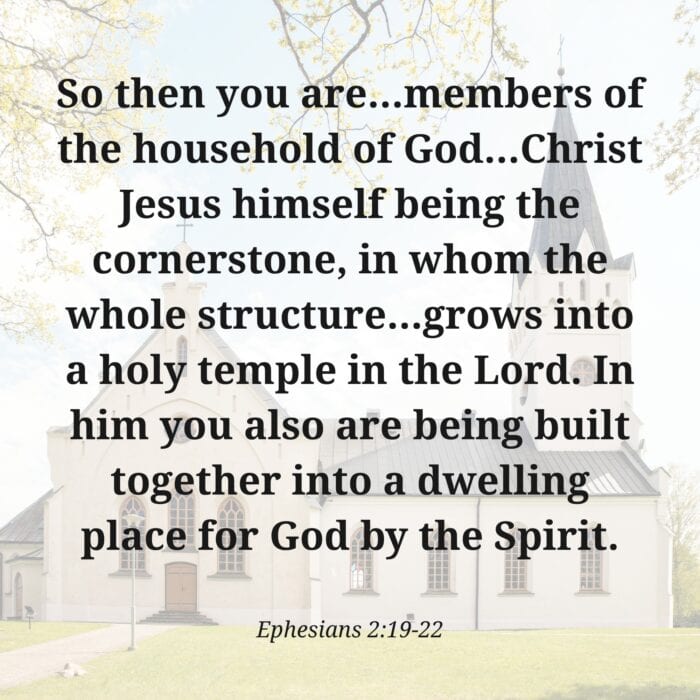
That common bond means that I can have women in my Bible study that do not attend my church, and we are all part of the Body of Christ. It means churches that hold to salvation by faith in Christ through grace alone can work together to reach their communities and minister to unbelievers, because we have a common faith and a common goal: to share the love of Christ and the truth of the gospel.
I’m also emphasizing this distinction because it will come up time and again in the articles that follow. I am writing about women’s ministry and what it could look like in evangelical churches. I am also writing to an American audience instead of one local church audience. Taken together, when I write about what the church could do, I will be thinking of local churches, like mine and yours. But I will also be thinking, “No church can do everything.” And so, what the church – the local church – could do will also necessarily be about the universal Church, not any one body of believers.
This matters for a few reasons. First, as I stated above, no single local church can do everything. But second, and perhaps more importantly, the universal Church is uniquely positioned to address the broken world we inhabit, which is populated with broken people for whom Christ died.
As believers, we alone, among all belief systems, truly understand the problem humanity faces, and the extensive impact sin has not only on individual lives, but also on families, societies, cultures, countries, and even the planet itself. And understanding a problem, defining a problem accurately, is always the first step to solving a problem.
So What?
What does all this – creation, sin and the fall, common grace, redemption, and the church – mean for women’s ministry? Why am I starting this series of articles with an article that barely mentions ministry or women? Good questions, great questions, because they get to the heart of ministry, to women or anyone else.
The articles that follow will dive deep into problems women in our communities are facing in 21st-century America. I suspect many women around the globe are facing similar problems as well. I’ll be sharing statistics and describing concerns around marriage, parenting, poverty, loneliness, mental health, and more. In each of these articles, I’ll follow the same format, using these foundational theological truths.
First, I’ll describe the problems women face. These sections will be heavy on statistics. They will also reflect the reality of living in a sin-wracked world. Varying from the order presented in this article, I’ll then return to the ideal, to answering the question, “In a perfect world, what would marriage/mental health/other concerns look like? Or would they even exist?”
Next, I’ll try to include glimmers of hope, born out of common grace, as I discuss how society has tried to handle the problems raised. Then, the hope of redemption and restoration will be introduced through biblical truth applied to these various areas of life. Finally, I’ll present some ideas, certainly nowhere near an exhaustive list, of what local churches and the universal Church together might do to bring hope and healing to the lives of women, regardless of their needs, season of life, situation, or even status as a believer or not.
That last point matters a lot. Church history teaches us, if we take the time to learn, that caring for the broken people around us is not optional; it is an essential component of the Church. In addition to showing the love of Christ to all, compassionate care of others not only attends to their physical or emotional concerns, but also their spiritual needs. Caring for others’ temporal needs opens a door to sharing the gospel of Jesus Christ, the gospel of not only truth – about sin and salvation – but also of hope. Hope for this life as well as eternity.
Each local church will need to decide for itself what, if anything, it will do in the face of the multiple crises facing women in our culture. Some may choose to do nothing. Were I in those churches, I would be highly tempted to make a ruckus or find a more compassionate place of worship. Most, however, I hope and believe, will do and are trying to do their best to handle exploding crises not only among women, but also among men, the elderly, youth, families, and any other segment of humanity we can name.
My hope and prayer is that this series of articles will accomplish two goals. First, they will lay out in stark detail the crises women are facing and confront the church with its responsibility to do something. Second, these articles will contain suggestions about what churches could do. I don’t care if any church anywhere adopts any of these suggestions. My greater hope is that these ideas will get the creative juices flowing and more, better ideas will crop up in hundreds or thousands of churches across the nation. In short, I hope that churches will come to recognize the crises we’re living through and then rise, boldly and biblically, to meet the crises head-on with the love and grace of the gospel of Jesus Christ. I invite you to read the initial article describing the crises women face, and return every other week for each following article as I explore applying Scriptural truth and a biblical worldview to current issues in our culture.
